The Ultimate Guide to Salary Negotiation in 2026: Get Paid What You’re Worth

Three weeks ago, a product designer I know — really talented, eight years in, portfolio full of shipped products — got offered a senior role at a company she genuinely wanted to work for. Great team, interesting problems, the whole package. The offer was $22k below what her peers were making. She had the data. She knew the gap. And she was about to accept it anyway because, and I quote, "I don't want to rock the boat."
She's not unusual. About 60% of professionals never negotiate at all. They take the first number, say "thank you," and spend the next two years quietly resenting it. Over a career, that politeness costs somewhere between $500k and $1M in lost earnings. That's not a typo.
Here's what makes 2026 different from even five years ago: your "market value" isn't a static number buried in a Glassdoor report. It's a moving target shaped by AI skill premiums, remote work arbitrage, and genuine talent shortages in specific niches. The first number a company offers you is almost never their best number. It's a starting position. They expect you to push back. When you don't, you're not being "easy to work with" — you're leaving their budget surplus on the table.
Before You Open Your Mouth: Do the Homework
"I feel like I deserve more" is not a negotiation strategy. Feelings don't survive contact with a hiring manager who does this ten times a week. Data does. And in 2026, "I checked Glassdoor" isn't enough — you need to triangulate from multiple sources because any single platform has blind spots.
- Triangulate your data: Pull from at least 3-4 sources. Adjust for your city (yes, remote work has flattened geography, but cost-of-labor differences are still very real—you can even calculate your silence tax), your industry vertical (a senior engineer at a fintech startup and a senior engineer at a nonprofit live in different salary universes), and the specificity of your experience.
- Audit your rare skills: If your role involves something that's hard to hire for — AI integration, compliance in regulated industries, platform migration expertise — that scarcity is worth real money. Write these down. You'll need them later when someone says "our budget is fixed."
- The "Vegas Test": Ask yourself: if you walked out today and applied at a competitor tomorrow, what would they pay you? Not what you'd hope for — what would an actual offer letter say? That number is your real market value. Everything else is noise.
Step 2: The New Math: Mastering Total Compensation (TC)
Most people focus only on the base salary. This is a crucial mistake. In 2026, companies often keep base salaries lower to control fixed costs, but they increase variables. You must negotiate the Total Compensation (TC) package. You are negotiating the sum of four parts:
Let’s break down this formula:
| Component | What it is | Why it matters |
|---|---|---|
| Base Salary | The fixed cash you get every two weeks. | This is the foundation that all percentage-based bonuses and raises are calculated on. |
| Bonuses | Cash payments based on personal performance, company performance, or a sign-on incentive. | This is how you close a fixed salary gap. A $10k base gap can be solved with a $15k sign-on bonus. |
| Equity | Stock Options or Restricted Stock Units (RSUs). | The primary path to long-term wealth. If the company is growing, this is the most valuable lever. |
| Perks & Benefits | Health insurance premiums, 401(k) match, stipend for home office, PTO, and professional development budgets. | Do not underestimate this. Negotiating for a $5k tuition stipend or a 4-day work week can often be easier than a base salary raise and adds massive value to your quality of life. |
Step 3: Strategic Negotiation Tactics for 2026
Once you know your value and understand the components, it is time to execute.
1. Avoid Being "Anchored" First
The oldest trick in the book is the company asking: "What are your salary expectations?" The first person to name a number gets anchored to that number, which often leads directly into the "salary is negotiable" trap.
The 2026 Pivot:
"Right now, I am focused on finding the right fit for my skill set. I’m open to discussing any competitive offer that aligns with the market value of the role and its responsibilities."
2. Give a Range, Not a Number
If you must name a range (perhaps when applying), make your "Target" number (what you truly want) the bottom of your range.
- Your Target: $125,000.
- Your stated range: $125,000 - $135,000.
- (They will almost always offer the $125k, but they may surprise you).
3. Visualize the Deal: The Zone of Possible Agreement (ZOPA)
This is the key visual framework that professional negotiators use. Every negotiation exists within an overlap. If there is no overlap, a deal cannot be made. Your goal is to find the overlap and anchored yourself to their "Employer’s Cap."
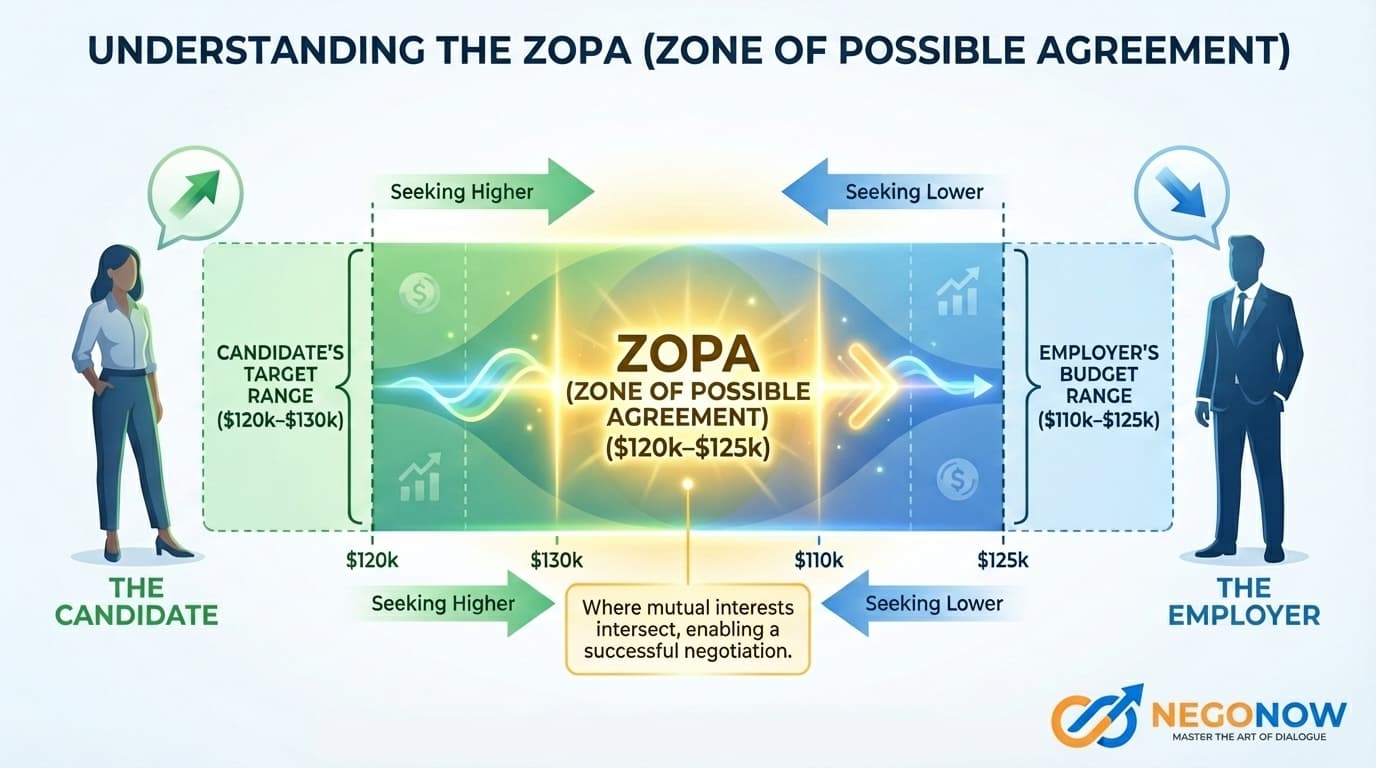
- Your Lowest Acceptable: This is your "walk-away" number.
- Employer’s Target: This is the low offer they hope you will accept.
- The ZOPA: The entire space where a mutually beneficial deal is possible.
The Part Where Knowing Isn't Enough
Here's the uncomfortable truth: you can read every guide on the internet and still freeze when the recruiter pauses after your number. Knowledge and execution are different animals. The gap between "I know I should negotiate" and actually doing it well is enormous, and overcoming the fear of "no" is critical. It's the difference between reading about swimming and jumping in the pool.
That's why we built NegoNow as a simulator, not a calculator:
- AI Roleplay: Practice against an AI that throws real objections at you — "We don't have budget for that," "We don't match competing offers," "That's outside our band." You practice staying composed when your instinct is to cave.
- Custom Talking Points: Feed it your job description and industry, and it generates specific arguments based on current market data. No more winging it with generic templates from a 2019 blog post.
- Counter-Offer Analysis: Paste in the offer email and get an instant read on whether it's fair, where the gaps are, and exactly how to respond.
One more thing worth saying: "Win-Win" doesn't mean 50/50. It means both sides walk away with their core needs met. Sometimes your core need is salary. Sometimes it's equity, or flexibility, or a title that unlocks the next promotion. The best negotiators figure out which lever matters most — and push that one hard.
Related Reading:
— Written by the NegoNow Team