Overcoming the Fear of 'No': The Psychology of a Win-Win Negotiation

Last year, a friend of mine — senior engineer, ten years’ experience, genuinely brilliant at distributed systems — called me the night before her offer deadline. "I'm just going to take it," she said. The offer was $30k below market. She knew it. I knew it. But then she said the words I’ve heard a hundred times: "I don't want to seem difficult."
I hear some version of that conversation roughly twice a month. Different people, same three phrases, like a script nobody remembers writing:
"What if they rescind the offer?"
"I'm just happy to have the job."
"I don't want to look greedy."
Here’s the thing nobody in HR will tell you: the anxiety is real, but the danger is almost entirely imagined. About 60% of professionals report physical dread at the thought of negotiating salary. It makes sense — we’re literally wired for it. Back in the savannah days, social rejection meant exile, which meant death. Your nervous system hasn’t gotten the memo that it’s 2026 and the actual worst-case scenario is a mildly awkward Zoom call.
The irony is thick: the companies actually worth working for? They respect the people who push back. It signals you understand your own value. And that’s exactly the kind of person they want on the team.

Stop Thinking of It as a Fight
Most people treat negotiation like a zero-sum tug-of-war — if I gain $5k, the company loses $5k. This framing is wrong, and it’s the single biggest reason people freeze up before they even open their mouths.
Think about it differently. You and the recruiter are both staring at the same puzzle: "How do we structure this so this person doesn’t start quietly job-hunting six months from now?" Because that’s what actually happens when people accept lowball offers out of politeness. They get resentful. They burn out. They leave. And replacing them costs the company 1.5x to 2x their annual salary.
The reframe that changes everything:
You’re not "asking for more." You’re solving a retention problem before it starts. Every experienced hiring manager knows this — the ones worth working for will appreciate that you’re thinking long-term.
Leverage Isn’t a Feeling — It’s Arithmetic
A lot of the fear comes from a vague sense of powerlessness. "They hold all the cards. They have the offer." But here’s a secret: leverage isn’t some mystical force. It’s math. And once you run the numbers, you might realize you’re holding way better cards than you thought.

When They Say "No," the Real Conversation Starts
Chris Voss — the FBI hostage negotiator who wrote "Never Split the Difference" — has this line I keep coming back to: "No" isn't the end of a negotiation. It's the beginning. Most people hear "No" and their stomach drops. They start mentally packing up. But "No" almost never means "absolutely not, get out of my office." It usually means "I'm not comfortable with those specific terms yet."
Big difference.
What to say next:
Don't argue. Don't justify. Ask a question that puts them in problem-solving mode:
"What would it take for us to get to [Target Number]?"
"How does this offer compare to the budget you've allocated for this role's expected impact?"
Something subtle happens with questions like these: the recruiter shifts from opponent to collaborator. They stop defending a number and start helping you find the money. And more often than you'd expect, they know exactly where to look.
The Hardest Skill: Shutting Up
I once watched someone negotiate himself down by $15k in a single sentence. He asked for $145k — good number, well-researched. Then, before the recruiter could even respond, he panicked at the silence and added: "...but I mean, if that's too high, I could probably do $130k."
Fifteen thousand dollars, gone in two seconds. Because silence is excruciating and our brains are desperate to fill it, proving that silence and professionalism can be a costly mix if you break first. It's crucial to understand why the 70/30 principle is the only way to win.
The rule is dead simple:
State your number. Then close your mouth. Count to ten in your head if you have to. The other person will almost always fill the silence, and when they do, they often fill it with a concession.
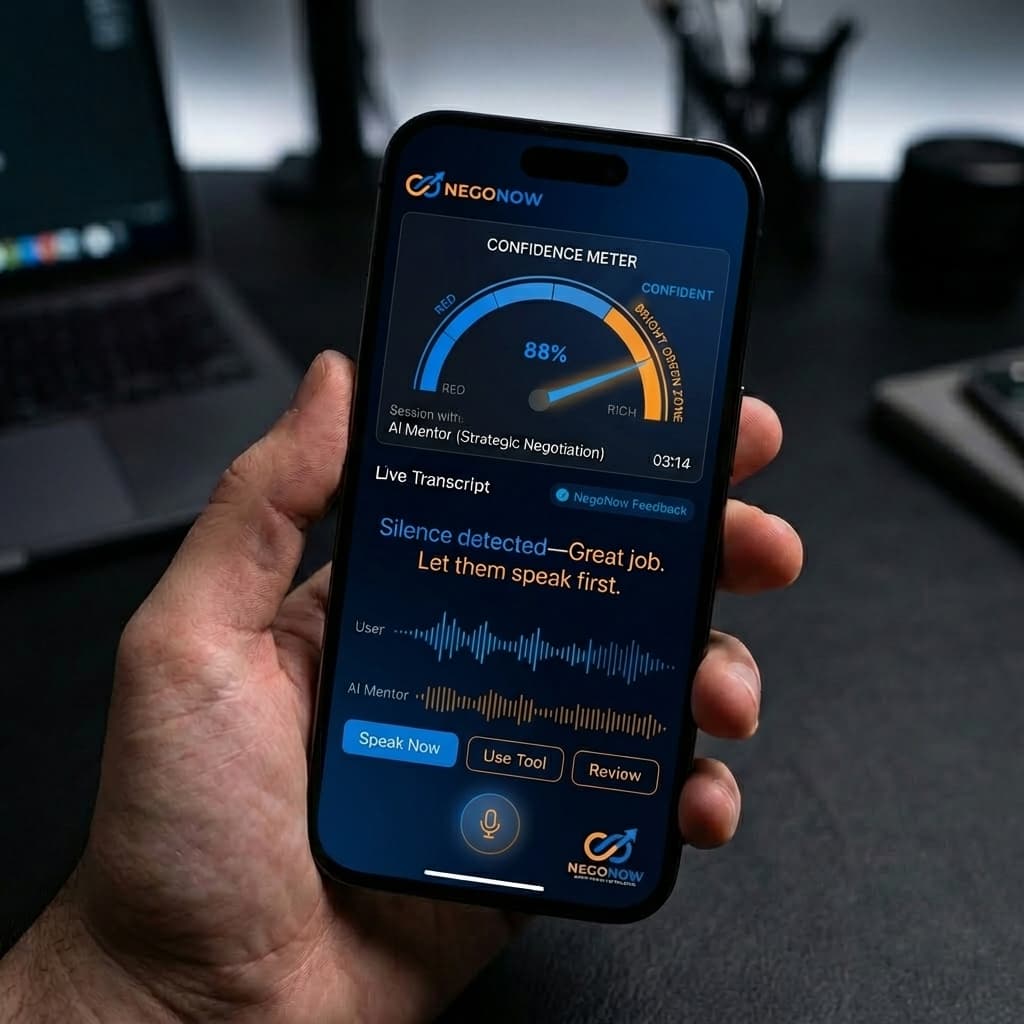
You Can't Think Your Way Out — You Have to Practice
Reading about negotiation is necessary but not sufficient. It's like reading about swimming — at some point you have to get in the water. The problem is that most people's "first swim" is the actual high-stakes conversation, when real money is on the line and their heart is pounding. Terrible time to learn.
This is why we built NegoNow around practice, not just information:
- AI Roleplay: The AI doesn't just hand you proven salary negotiation scripts. It argues with you. It says "No." It throws curveballs. You practice staying composed when your gut wants to fold.
- Sentiment Analysis: After each round, you get an honest read on whether you sounded apologetic or authoritative. Most people don't realize how uncertain they sound until they hear it played back.
- BATNA Builder: Map out your alternatives before the conversation starts. Knowing you have a Plan B changes the entire dynamic — even if you never mention it out loud.
Nobody is born confident at this stuff. Every good negotiator I know was terrible at it once. The difference is they practiced before the stakes were real.
Related Reading:
— Written by the NegoNow Team