Setting the Tone: The Cinco de Mayo Guide to the "First Anchor" Advantage

We’ve all been taught that the person who speaks first in a negotiation is at a disadvantage. "Let them show their cards," they say. "Wait for the offer." But here’s the reality: in 2026, waiting is just another way of letting someone else define your value. If you wait for an HR manager to name a salary, you’re letting them anchor the conversation at the bottom of their budget.
Cinco de Mayo is about taking the initiative. It’s about realizing that the best way to win a battle isn’t to wait for the other side to make a move—it’s to set the terms yourself. When you name your price first, you aren't being aggressive; you're being the architect of the conversation. You’re setting the mental hook that every other number will be judged against.
The Master Series: Fundamental Negotiation Tactics
- The "Silent Pivot" Technique: How to use strategic pauses to force the other party to bid against themselves.
- Negotiating via Asynchronous Channels: Mastery of the "Negotiation Email"—how to maintain leverage when you aren't face-to-face.
- The Psychology of the First Anchor: Why you should (almost) always be the first to name a price, and how to do it without scaring the buyer.
- Mirroring and Labeling in Tech: Adapting the Chris Voss "Never Split the Difference" style specifically for software engineering and product management roles.
- Multi-Party Dynamics: How to negotiate when there are multiple stakeholders (e.g., your manager, HR, and the Department Head) all with different incentives.

Why the "First Anchor" Wins the Battle
The Anchoring Effect is a cognitive bias where the first number mentioned in a conversation sets a mental "hook" that all subsequent numbers are judged against. This is a critical component of uncovering "Black Swan" hidden information during the negotiation. If you wait for an HR manager to offer a salary, they will likely anchor at the bottom of their budget. By going first, you force them to adjust from your position rather than the other way around.
The Mathematics of the Settlement Point
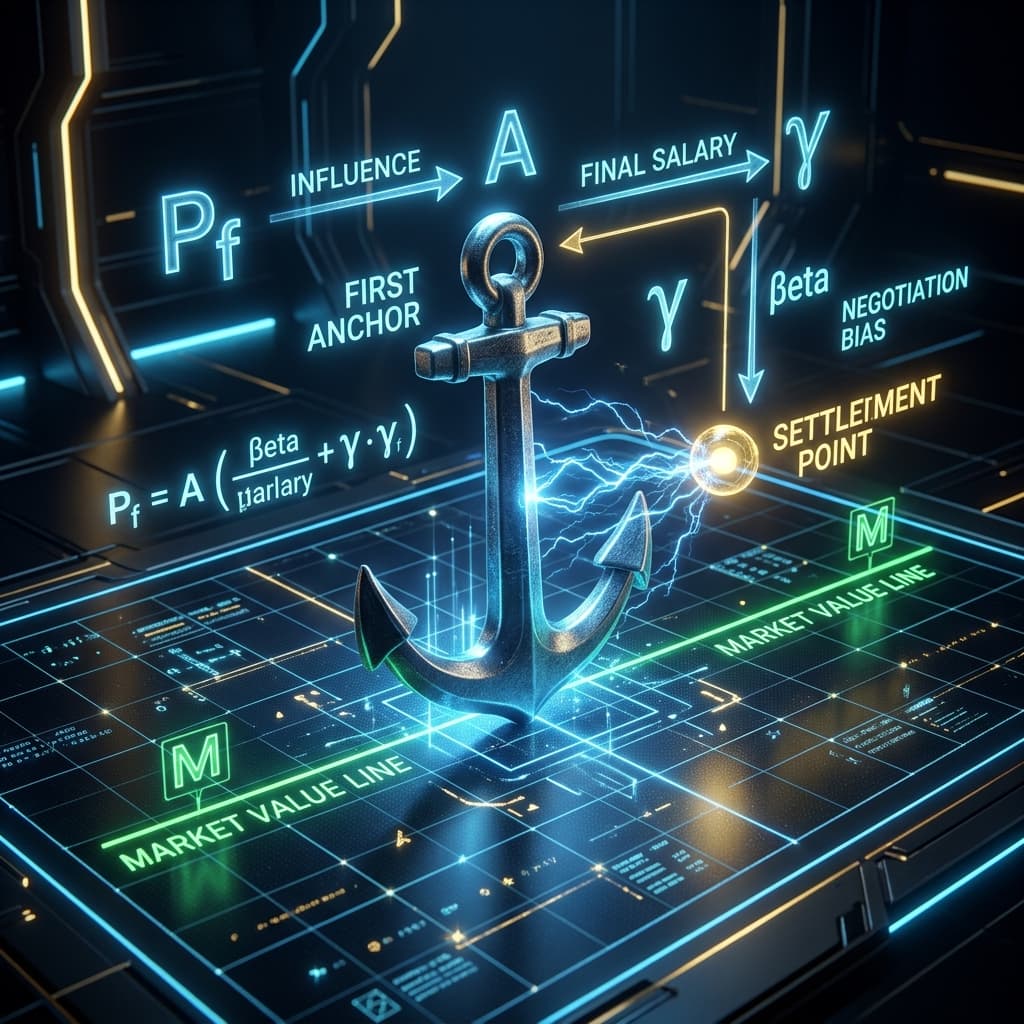
The final agreement price (Pf) is rarely a random number. It is typically a function of the first anchor (A), the market reality (M), and the "Adjustment Coefficient" (β)—which represents the negotiation skill and flexibility of both parties.
- If you set a high but defensible anchor (A), you mathematically pull the settlement point (Pf) toward your goal, even if the other party negotiates "down."
- If you let the employer anchor first with a low number, you spend the entire meeting fighting just to get back to "fair market value."
How to Anchor Without "Scaring" the Counterpart
The biggest fear in anchoring is being "too aggressive" and ending the conversation. To avoid this, use the NegoNow "Ambitious but Defensible" (ABD) Framework.
1. Use a Data-Backed Range
Instead of a single number, offer a range where your "target" is the floor.
The Script:
"Based on my research into the current 2026 market for Lead Product Managers and my specific track record with AI integration, I’m looking for a total compensation package in the $185k to $210k range."
2. The "Bolstering" Technique
Anchor your perks alongside your salary. By bundling high-value, low-cost items (like remote work flexibility or specialized training budgets) with your salary anchor, the "price" feels like a comprehensive value exchange rather than just a cost.
3. Precision Matters
Psychological studies show that "precise" numbers (e.g., $147,500) act as stronger anchors than "round" numbers (e.g., $150,000). A precise number suggests you have done rigorous math to arrive at that value, making it harder for the other side to dismiss.
Practicing Your Lead with NegoNow
Setting an anchor requires confidence. If you hesitate or use "filler words" (like "um" or "I think"), the anchor loses its weight.
With NegoNow, you can use our Anchor-Tester. State your opening offer to the AI, and our sentiment analysis will tell you if you sound assertive or apologetic. We’ll help you refine your negotiation scripts so that when Cinco de Mayo rolls around, you aren't just celebrating—you're winning.

Don’t wait for the market to tell you what you’re worth. This May, take the initiative, set the anchor, and command the conversation.
— Written by the NegoNow Team